Key Takeaways
- SEO is a long-term investment. Most small businesses begin seeing early progress within 3–6 months, while significant traffic, leads, and ROI typically take 6–12 months of consistent optimization.
- Success is more than rankings. Early SEO wins include increased indexing, higher search impressions, growing organic traffic, and more qualified leads—not just reaching the #1 spot on Google.
- Your industry and website history matter. Local businesses and established websites often achieve results faster than brand-new websites or businesses in highly competitive industries like law, finance, and healthcare.
- Consistency accelerates growth. Regularly publishing high-quality content, improving technical SEO, optimizing your Google Business Profile, and earning quality backlinks help shorten the SEO timeline.
- SEO delivers compounding returns. Unlike paid advertising, SEO continues generating traffic and leads over time, making it one of the most cost-effective long-term marketing strategies for small businesses.
This is the single most frequent, and most painful, question small business owners ask. The honest answer is rarely satisfying at the moment: SEO typically takes 3 to 12 months to deliver meaningful results.
But that number alone doesn’t tell the full story. A local bakery can see phone calls within 60 days, while a new personal injury law firm might not crack page one for a year. The timeline is a moving target, and defining “results” only as a #1 ranking guarantees frustration.
This guide is your complete roadmap. We’ll break down the month-by-month reality, the factors that speed up or slow down your progress, how to measure success long before you see rankings, and exactly what you should expect at every stage so you can invest in SEO with confidence, not guesswork.
What Does “SEO Results” Actually Mean?
Most small businesses make a critical mistake: they define success only as a #1 Google ranking. In reality, SEO results happen in five progressive layers:
- Crawling and Indexing: Google discovers your pages. No visibility yet.
- Ranking Movements: Moving from position 80 to 40. You’re invisible on the front end, but progress is real.
- Organic Traffic Growth: Visitors start arriving from search for the first time.
- Lead Generation & Conversions: Those visitors call, fill out a form, or make a purchase.
- Revenue & ROI: The money you can directly attribute to organic search becomes clear and positive.
Expecting a flood of sales in month two will lead you to abandon the strategy right when it’s about to compound. You need to track all five stages, especially the early ones, to understand the full picture.
SEO doesn’t have to be a guessing game. With the right strategy, technical optimization, and content plan, you can build sustainable rankings that generate qualified leads month after month.
Whether you’re launching a new website or trying to improve existing rankings, we provide data-driven SEO services tailored specifically for small businesses.
The Honest Answer: A General Timeline Overview
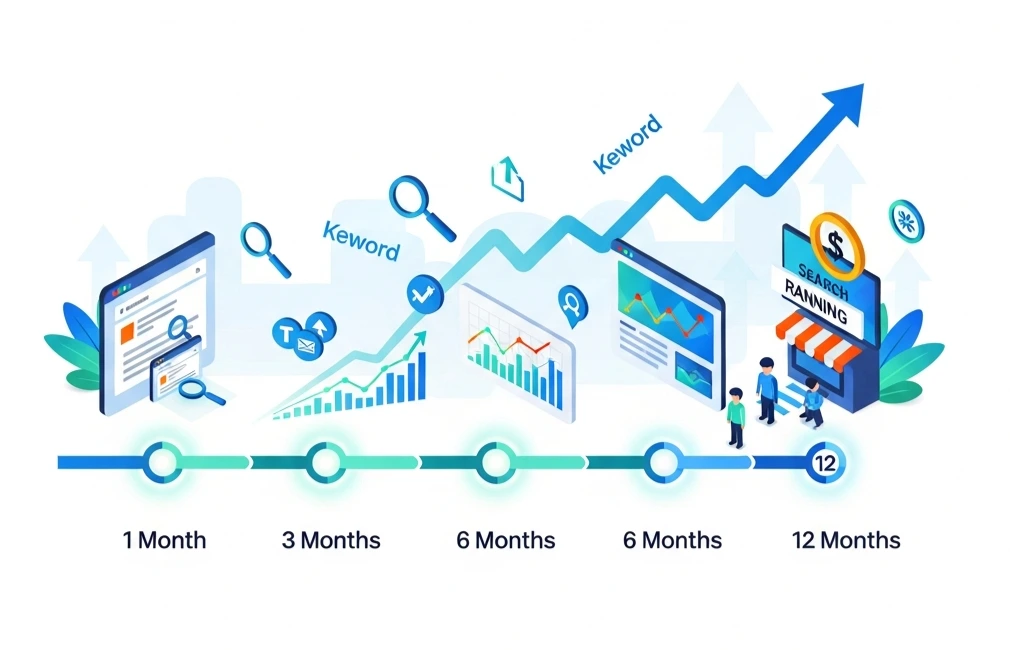
Based on aggregated data, Google’s own statements, and years of performance analysis, here is the realistic window for most small businesses:
| Stage | Timeline |
| Initial signals of progress | 1–3 months |
| Noticeable traffic and local visibility | 4–6 months |
| Significant, business-changing results | 6–12 months |
| Dominant, trust-based positioning | 12–24 months |
| Compounding, self-sustaining returns | 24+ months |
Key Stat: A widely cited Ahrefs study found that only 5.7% of newly published pages rank in the top 10 within a year. SEO is not slow; it is simply the steady accumulation of trust signals in a system designed to reward authority over novelty.
Month-by-Month Breakdown: Exactly What Happens
Month 1: The Audit & Foundation Phase
This is the “construction” month. You are invisible to customers, but you are fixing the frame of the house.
What’s happening:
- Full technical SEO audit and fixes (speed, mobile-friendliness, crawl errors)
- Setting up Google Search Console, Google Analytics 4, and accurate conversion tracking
- Thorough keyword research targeting realistic, high-intent terms often long-tail
- Claiming and fully optimizing your Google Business Profile (critical for local businesses)
- On-page foundations: title tags, meta descriptions, header structures, and internal linking blueprints
What you’ll see: Little to no change in traffic or rankings.
What to measure:
- Number of pages indexed
- Site health improvements
- Crawl errors resolved
- Baseline rankings recorded
Month 2: Content Engine & On-Page Optimization
You now start building the assets that will generate traffic.
What’s happening:
- Publishing the first batch of optimized service pages and blog posts (2–4 high-quality pieces)
- Implementing schema markup (local business, FAQ, product)
- Image optimization, alt tags, and Core Web Vitals improvements
- Starting citation building for local SEO (Yelp, industry directories, NAP consistency)
- Very early link-building outreach begins , guest posting and local partnerships
What you’ll see: Google re-crawls your site more frequently. Slight ranking twitches (e.g., position 85 to 60) for very long-tail phrases. Impressions appear in the Search Console.
What to measure:
- Increase in indexed pages
- First impressions data
- Tiny click-throughs for obscure queries
Month 3: Early Signals & First Small Wins
This is the month most people panic and quit because “nothing happened.” In reality, the seeds are germinating underground.
What’s happening:
- Google starts to understand your site’s topical relevance
- A few long-tail, low-competition keywords crack page 2 or even late page 1
- Google Business Profile interactions (calls, direction requests) start rising visibly
- Backlinks from month two’s outreach begin to be recognized
What you’ll see: Your very first organic traffic trickle often 10–30% over a baseline of near-zero. A handful of keywords in positions 11–30.
What to measure:
- Impression growth trend
- Number of keywords in the top 50
- GBP insights (views, calls)
Months 4–6: The Growth Phase
This is where patience turns into tangible business momentum.
What’s happening:
- Your content library now has 10–20+ mature, interlinked, authoritative pages
- Domain authority slowly climbs as acquired backlinks take full effect
- Long-tail keywords routinely hit page 1; medium-competition terms climb to page 2 or 3
- Featured snippets start appearing for question-based content
- For local businesses, map pack presence becomes consistent
- The first measurable leads come in form fills, phone calls, or online orders directly from organic search
What you’ll see: Traffic doubles or triples from its early trickle. Organic visitors convert better than any other channel. You start to feel the momentum.
What to measure:
- Month-over-month organic traffic growth
- Number of keywords on page 1
- Conversion rate and cost per lead from organic search
- Total organic revenue
Months 6–12: Significant Results & Scaling
Your SEO engine is now firing on all cylinders.
What’s happening:
- Page 1 rankings stabilize; medium-to-high competition keywords finally appear on the first page
- Organic traffic becomes one of your primary sources of new business, often overtaking social media and sometimes even paid ads
- Brand searches increase because people are hearing about you and looking you up specifically
- Older content continues to drive traffic without extra work the compound effect is here
- You can afford to reduce PPC spend and reinvest the savings, further lowering your cost per acquisition
What you’ll see: A consistent, predictable flow of leads. Your ROI is clearly positive. You know exactly what a new piece of content is worth.
What to measure:
- Total organic revenue vs. total SEO investment
- Number of #1–3 rankings for key money terms
- Market share of voice
Months 12–24: Dominance & The Compound Effect
SEO becomes your most defensible business asset.
- Authority is established: You can now rank for highly competitive terms that were impossible at launch
- You’ve built a content moat: Hundreds of indexed pages acting as a barrier competitors cannot easily replicate
- Traffic is self-sustaining: Even a temporary slowdown in publishing won’t kill your momentum
- Cost per result keeps dropping: Unlike ads, SEO gets cheaper and more profitable the longer you do it
Factors That Accelerate or Delay Your SEO Timeline
Your specific timeline hinges on where you start and what you do. These factors can cut your wait in half or stretch it years.
Factors That Speed Up Results
- Hyper-local or low-competition niche: Ranking a local electrician is far faster than a national software company
- Active Google Business Profile: Regular posts, reviews, and photos signal local relevance rapidly
- Existing aged domain: A 3-year-old site with some history ranks faster than a brand-new domain
- Aggressive high-quality publishing: Consistently publishing deeply useful, expert-level content builds authority faster
- Strategic, authentic link building: Earning links from local media, partners, and quality guest posts
- Long-tail keyword targeting first: Winning “how to fix a leaky kitchen faucet without calling a plumber” builds the trust to eventually rank for “plumber near me”
Factors That Slow Down Results
- Highly competitive verticals: Law, insurance, health. You are battling corporate giants with decades of authority
- Brand new domain: Widely observed “sandbox” effect adds 3–6 months of trust-building
- Severe technical issues: Slow load times, broken mobile layouts, and no HTTPS kill your momentum before it starts
- Inconsistent effort: Stopping and starting every few months resets your progress to zero each time
- Unrealistic keyword focus: Trying to rank a 5-page site for “best business loans” is an exercise in futility
- Toxic or purchased backlinks: They can trigger manual penalties that take months to fix
Timeline by Industry: Real-World Expectations
| Industry | Competition Level | Page 1 Timeline | Key Success Driver |
| Local Plumber / HVAC | Medium | 3–6 months | Optimized Google Business Profile |
| Local Restaurant | Low–Medium | 2–4 months | Reviews, GBP posts, local citations |
| Niche E-commerce (specialty goods) | Medium–High | 6–12 months | Deep product descriptions + buying guides |
| Dental Practice | High | 6–12 months | E-E-A-T, patient reviews, local authority |
| Legal Services | Very High | 9–18 months | Hyper-local focus first, massive authority building |
| Home Services (cleaning, landscaping) | Low–Medium | 3–6 months | Local SEO dominance + service area pages |
| Accounting / Financial Advisor | High | 6–12 months | Trust signals, credentials, high-quality content |
Key Insight: Small businesses that serve a local geography have the strongest advantage. You can often start ranking in the local map pack months before you ever crack the traditional blue links for a competitive term.
New Website vs. Existing Website: The Starting Point Gap
Your domain’s history dramatically alters the timeline.
New Website (under 6 months old)
- Timeline: 6–18 months to significant results
- Reality: You must earn trust from zero. Google treats you as unproven. Go all-in on long-tail content and local signals to shorten the wait.
Existing Website (1–3 years old, minimal prior SEO)
- Timeline: 3–9 months to significant results
- Reality: You already have some domain authority. Fixing technical debt, optimizing current pages, and adding consistent content can produce fast wins, often within the first quarter.
Established Website (3+ years, some SEO history)
- Timeline: 2–6 months for meaningful lift
- Reality: You are building on an existing foundation. Optimizing underperforming pages that sit on page 2 is often the single fastest way to generate new leads.
How to Measure Progress Before You See Rankings
Quitting at month three because “I’m not on page one” is the number one reason small businesses fail at SEO. You must look at the leading indicators that prove the engine is working deep beneath the surface.
Track these metrics in months 1–3 to see the invisible growth:
| Metric | What It Tells You |
| Google Search Console Impressions | Even without clicks, rising impressions mean Google is starting to consider your pages, the #1 early indicator |
| Total Keywords in Any Position | Moving from 50 to 500 keywords in the top 100 is enormous progress |
| Crawl Frequency | A faster crawl rate indicates growing trust from Googlebot |
| Pages Indexed | Use site:yourdomain.com a steadily rising count means content is being accepted |
| Average Position | Going from position 82 to 41 is huge, you’ve jumped halfway up the mountain |
| Backlink Growth | Track new, relevant domains linking to you monthly |
| GBP Insights | Rising map views, calls, and direction requests often happen in months 2–3 |
| Branded Search Volume | More people searching your business name = growing awareness |
The Investment Equation: What You Pay Directly Affects the Timeline
SEO costs money or time, and underinvestment is the silent killer of timelines.
| Monthly Investment | Expected Realistic Timeline | What You Typically Get |
| $500–$1,000/month | 8–16 months | Basic local SEO, limited content, some technical fixes |
| $1,000–$2,500/month | 5–10 months | Consistent content, link building, solid local & on-page work |
| $2,500–$5,000/month | 4–8 months | Aggressive strategy, frequent high-quality content, strong link campaigns |
| $5,000+/month | 3–6 months (in most niches) | Full-scale operation, dedicated team, fastest authority gain |
| DIY (only time invested) | 12–24+ months | Slow progress governed by your learning curve and available hours |
The key comparison: If you spend $2,000/month on Google Ads, switching $1,500 of that to SEO with a 12-month plan leaves you with a permanently climbing asset that gets cheaper and stronger forever. PPC stops the second you stop paying. SEO doesn’t.
Common Mistakes That Add Months to Your Timeline
Common Mistakes to Avoid these momentum killers that quietly stall progress before you even notice:
- Giving up in month 3: SEO is a front-loaded effort with back-loaded rewards. The compound effect hasn’t kicked in yet.
- Targeting head terms first: A small bakery targeting “wedding cakes” nationally will wait forever. Target “custom wedding cakes in [city].”
- Ignoring technical health: Perfect content on a broken, slow site will not rank.
- Not building any backlinks: Content without promotion is a billboard in the desert.
- Inconsistent publishing: A burst of effort followed by silence signals instability.
- Regurgitating competitor content: Without original data, case studies, or genuine expert opinion, you’re just adding noise.
- Neglecting your Google Business Profile: For any local business, this is the single biggest missed quick win.
- Hiring cheap SEO with guaranteed overnight results: These strategies build toxic links and often result in penalties that take years to reverse.
- Not tracking conversions: If you can’t prove the leads came from organic search, you won’t know if it’s working.
The Compound Effect: Why You Can’t Afford to Wait Another Year
Here is the math that makes small business SEO the highest-ROI channel in existence:
| Year | Monthly Investment | Leads per Month | Cost Per Lead |
| Year 1 | $2,000/month | 20 leads | ~$100/lead |
| Year 2 | $2,000/month | 40 leads | ~$50/lead (cut in half) |
| Year 3 | Reduced maintenance spend | 50+ leads | ~$20/lead (and still falling) |
Compare that to PPC, where your cost per lead never decreases.
- PPC = Renting access to an audience (stops the second you stop paying)
- SEO = Owning the real estate (continues and grows even with reduced investment)
The best time to buy that property was five years ago. The second best time is today.
Conclusion
SEO is one of the best ways for small businesses to grow online, but it requires patience and consistency. In most cases, you can expect to see early improvements within 3 to 6 months and stronger business results within 6 to 12 months. The exact timeline depends on your industry, competition, and how consistently you invest in improving your website.
It’s also important to remember that SEO isn’t something you complete once and forget. Search engines change, competitors update their websites, and customer needs evolve over time. Keeping your website updated with helpful content, fixing technical issues, and improving your online presence will help you stay competitive.
As your SEO campaign grows, don’t judge success by keyword rankings alone. Look at the bigger picture. Are more people finding your website? Are you getting more phone calls, contact form submissions, quote requests, or sales? These are the results that have the biggest impact on your business.
The businesses that get the best results from SEO are usually the ones that stay committed, even when progress feels slow at first. Every improvement you make,whether it’s creating useful content, earning trusted backlinks, or improving your website’s performance,adds to your long-term success.
Over time, those small improvements build on each other. That’s why SEO often becomes one of the most cost-effective marketing channels for small businesses, helping you attract qualified customers and grow your business for years to come.
Frequently Asked Questions
Can SEO work in 30 days?
SEO usually does not produce real results in just 30 days. In the first month, search engines are still crawling your site, indexing pages, and processing changes. You might see small signs like impressions or indexing, but meaningful traffic and rankings normally take longer.
Why did my rankings drop after improving my website?
This can happen after updates because Google needs time to re-evaluate your site. Rankings may shift during re-indexing or algorithm updates. Small drops are normal at first and often stabilize once search engines fully understand your changes.
Does blogging speed up SEO?
Yes, but only when the content is helpful. Blogging can speed up SEO by targeting new keywords, answering customer questions, and building authority. However, low-quality or random posts will not help and may slow progress.
Can I do SEO myself?
Yes, basic SEO can be done by small business owners. You can optimize pages, write content, and set up your Google Business Profile. However, for competitive industries or faster growth, hiring an expert can save time and improve results.
How much should a small business invest in SEO?
There is no fixed amount. It depends on your goals and competition. Small local businesses may start with a modest monthly budget, while competitive industries often need more investment. A good rule is to invest enough to consistently improve your website, content, and authority over time.